


What Hill Country Animal Lovers Need to Know About New World Screwworms


The recent headlines about “flesh eating parasites” and "carnivorous worms” sound like something straight from a horror story, and can be easy to dismiss as sensational news. For those who haven't yet heard of the insects in question, a dangerous variety of blowfly called the New World Screwworm (NWS) has reappeared in the United States for the first time in decades (1). New World Screwworms are considered to be one of the most destructive livestock pests in all of history, and they pose a genuine threat to the animals in our community.
In less than two weeks, eight confirmed cases of New World Screwworm infestations have been reported in the state of Texas (9), and this number is expected to steadily climb in the coming months. The Texas Hill Country is in the direct path of NWS quarantine zones, putting our pets, livestock and local wildlife at the heart of a growing danger. This is not cause for panic, but it does call for members of our community to play an active role in preventing further takeover. Learning to identify and report New World Screwworms will be critical.

What exactly is the New World Screwworm?
New World Screwworms are a variety of blowfly with one crucial difference from other members of their family: NWS larvae consume living rather than dead flesh (4). The female flies are attracted to the scent of wounds and body openings on warm blooded animals, and will lay their eggs in the soft, exposed tissue. A single female is capable of laying up to 300 eggs at a time and may target wounds no larger than a tick bite (2).
New World Screwworm eggs have a rapid gestation period, and the larvae can hatch and begin feeding on healthy tissue in less than 12 hours (4). Using their hooked teeth, NWS larvae “screw” into the flesh and create a wound that grows deeper each day as they consume the animal (2). Although the larvae start out quite small, they will grow to be nearly an inch in length before detaching from a host (6). The mature larvae drop and burrow into the ground after approximately one week of growth and feeding, and will reemerge in 7-54 days as adult flies (2).
Knowing their prolific reproductive cycle, you can begin to see the devastating potential! Female New World Screwworm flies are increasingly attracted to infested wounds and will lay additional eggs, creating a deadly cycle that leads to the death of the animal without intervention.

The Current New World Screwworm Situation in Texas
New World Screwworms are native to South America (3), and have been a decades-long issue for livestock in Mexico. In early 2025, Texas ranchers were warned that NWS were making a comeback and had once again been detected in cattle near the Texas-Mexico border (7). Fast forward to 2026, and as of June 15, nine confirmed cases have been reported in the United States (9). One of the most recent incidents involved an affected goat in Gillespie County, an area just north of Kerville and right in our backyard (7).
Warm temperatures, the rainy season, and abundant livestock and wildlife have made the Hill Country an ideal environment for New World Screwworms to thrive. The long distances between reported cases are a concerning indicator that NWS could be well established across the state. This led Texas Governor Abbott to issue a disaster proclamation (3), and the United States government to mobilize emergency protocols to contain and eliminate NWS in our state (13). Despite the government's implementation of proven protective measures like the Sterile Insect Technique, we are likely to see the number of cases multiply; it could take months to years to completely eliminate NWS from the state of Texas.
You can view the regularly updated map of infested/quarantined NWS zones here: TAHC Interactive NWS Zone Map
How to Protect Yourself and Your Animals from New World Screwworms
New World Screwworm infestations are a threat that can be identified early or prevented entirely by watchful pet owners. Wildlife and large herds of livestock run the greatest risk of infection due to the unlikelihood of regular inspections for physical symptoms of NWS. Pet and Livestock owners should remain vigilant and take the following precautions to protect themselves and their animals:
If you or your animals spend a lot of time outdoors, clean and cover any wounds promptly, including minor spots like scratches or insect bites (2). After cleansing the wound, you can apply antibiotic creams, invisible bandage, or clean dressings to protect them (18).
Monitor your animals daily, inspecting any wounds in addition to their ears, eyes, mouth, nostrils and genitalia (2).
Keep your dogs and cats current on monthly parasite and flea prevention (4). NexGard for dogs and NexGard COMBO for cats are reported to be effective against early-stage New World Screwworm larvae (15), but animals on prevention should still be monitored for signs of infestation. CapStar, an instant-action flea killing drug, can be administered to cats and dogs to kill existing NWS (15). Deceased larvae must still be manually removed by a veterinarian to prevent infection in the wound. You can see the complete list of FDA approved drugs here: Animal Drugs for New World Screwworm | FDA
People should use EPA-registered insect repellent when spending time outdoors (2). Do NOT spray human bug repellent on your pets! Search for certified EPA repellents here: Find the Repellent that is Right for You | US EPA
If flies are a common problem around your home, utilize tools like fly traps and citronella products to repel them.
Do not leave the doors or windows of your home open, especially while you are sleeping (2).
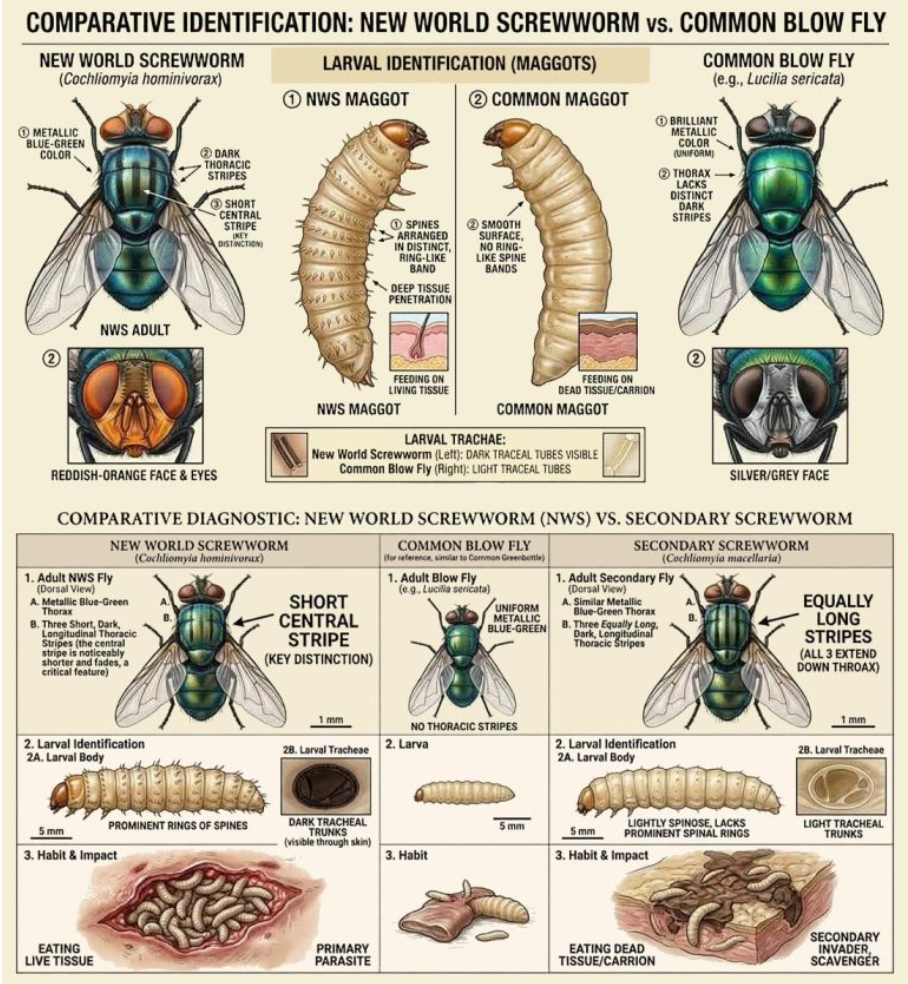
Purchase a fly swatter and eliminate flies in your home, watching carefully for the signature blue-green bodies and orange eyes of the New World Screwworm fly (there is a comprehensive NWS identification chart below).
If you or your pets work closely with livestock or wildlife, take extra precautions to cover any open wounds, and regularly check yourself and your pet for signs of eggs or larvae.
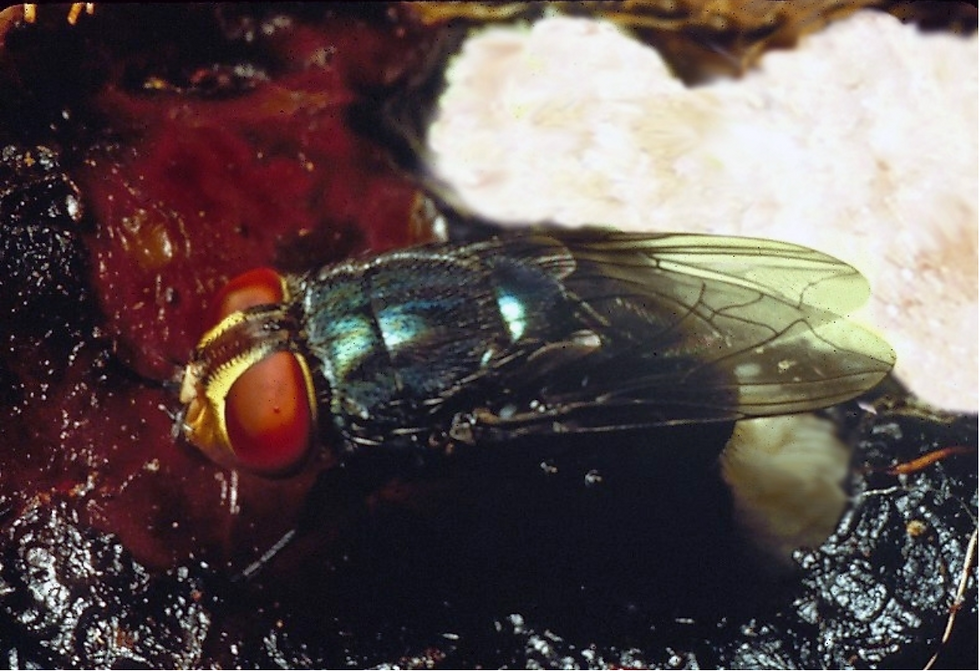
Adult NWS Fly and egg clusters on the wound of a host. Image courtesy of the USDA NWS Photo Gallery (9).
How to Identify a New World Screwworm Infestation
Learning to identify the signs of New World Screwworms is one of the most essential steps you can take to protect yourself and your animals from harm. A wound that begins to rapidly grow, sour or worsen is the earliest indication of an NWS infestation (4). Other symptoms to monitor for include:
Foul-smelling discharge from a wound (4).
Eggs or larvae visible in or around a wound or body orifice (4).
A wound demonstrating abnormal swelling, redness, discoloration or pain (4).
An animal exhibiting abnormal symptoms of stress, social withdrawal or a sudden despondent shift from their usual behavior (4).
Increased attention by the animal to a specific wound or body part, like chewing, itching, licking, head shaking or rubbing (4).
Keep an eye out for the same symptoms in wildlife around your property, as they are especially vulnerable to New World Screwworms. Any wild animals with an active infestation pose a risk to your pets and livestock, because mature larvae may drop from their wounds into the soil around your home.
Caution Due to their graphic nature, we have chosen not to include any photo references of New World Screwworm infestations in this article. You can view documented examples on the USDA website, but there will be numerous photographs of advanced cases: USDA NWS Photo Gallery
If You Suspect an Infestation
If you suspect or have identified a New World Screwworm infestation in yourself, one of your animals or a wild animal, you should treat it as an emergency and take immediate action. NWS larvae grow rapidly and can cause significant long-term damage in just a few days.
Pets and Livestock: If one of your animals is demonstrating symptoms of New World Screwworm infestation, immediately contact a veterinarian, and do not attempt to treat or remove the larvae without their instruction. Call the nearest emergency vet clinic for cases identified after business hours or over the weekend. You should seek treatment as quickly as possible, ensuring your animal is seen by a veterinarian within 24 hours.
Human infestation: If you or someone you know are affected, drive to the nearest emergency hospital or walk-in clinic for destruction and removal of the larvae. Do not attempt to wait for an appointment with your family physician!
Self removal of live larvae from yours or your animal’s wound is dangerous; it can cause extensive damage to surrounding tissue, and the larvae may burrow even deeper into the flesh. All New World Screwworms must be killed and manually extracted by a doctor or veterinarian to prevent deadly infection. If larvae naturally fall from a wound, pick them up with a glove or paper towel and drop them into 70% alcohol (2). Bring any preserved specimens with you to the hospital or veterinary clinic for examination.
Wildlife: If you believe a wild animal has been infested with New World Screwworms, promptly notify your local Animal Control Officer and Texas Animal Health Commission representative. Communicate the exact location of the animal, and the symptoms leading you to believe they have been affected by NWS.
You can locate contact information for your TAHC representative here: New World Screwworm - Diseases - Wildlife - TPWD
Reporting New World Screwworm Cases, and Preserving Specimen for Identification:
Reporting New World Screwworm sightings and infestations is absolutely critical to prevent them from spreading across the state. Whenever possible, you should photograph adult flies, larvae and larval infestations. Provide these photos to your doctor, veterinarian, and any other primary organizations responsible for tracking and controlling NWS populations. All New World Screwworm sightings and activity should be reported to one of the following entities:
Texas Animal Health Commission (TAHC): TAHC Office Contact Information
USDA Online Reporting System: Report Suspected Cases of Screwworm | APHIS
USDA Area Veterinarian in Charge: Animal Health Contacts | Animal and Plant Health Inspection Service

How to Identify NWS Flies and Larvae
There are several varieties of native Texas blowflies that can easily be mistaken for the New World Screwworm. Remember that the primary indicator for larvae is their diet: New World Screwworms target living flesh, while native blowfly larvae will consume dead or rotten materials. Texas Tech University details the following features which can help you distinguish New World Screwworms from native blowflies (17):
Adult New World Screwworm Fly:
Roughly twice the size of a common housefly.
Bodies are a bright, metallic blue-green.
Large, vivid orange eyes.
Three dark vertical stripes running behind the head.
The middle stripe will not extend all the way to the top of the head.
New World Screwworm Larvae:
Range from 3mm to 0.75 inches in length depending on their stage of growth.
White to cream in color, with dark spiral spines that give the worm a screw-like appearance.
Two dark breathing slits visible on the posterior of the body.
You can reference the identification chart below for a visual representation of the differences between New World Screwworms and native Texas blowflies. Capturing and submitting NWS specimens of any life stage can be invaluable to organizations that are researching the insects and combating their spread.
Learn more about preserving and submitting specimens here (scroll to the bottom of the article): CDC New World Screwworm Clinical Overview
Staying Informed Means Staying Safe
It will require a collective, vigilant effort, but we can see New World Screwworms eliminated from our communities. Monitor your animals, immediately pursue medical treatment for suspected infestations, and report NWS cases and sightings. HLCR will continue to monitor the situation and share updated information and local infested zones with our readers. Remain vigilant, and may you and your animals stay safe!
Governor Abbott Issues New World Screwworm Disaster Proclamation In June 2026
What Texas pet owners need to know about New World screwworm – Houston Public Media
What to Know About the New World Screwworm | College of Agriculture and Life Sciences
New world screwworm: Disaster declared, checkpoint established – Frio-Nueces Current
Animal Health Contacts | Animal and Plant Health Inspection Service
How to protect outdoor pets from New World screwworm | CIDRAP


Comments